DISARM THE RELIGIOUS - NOW
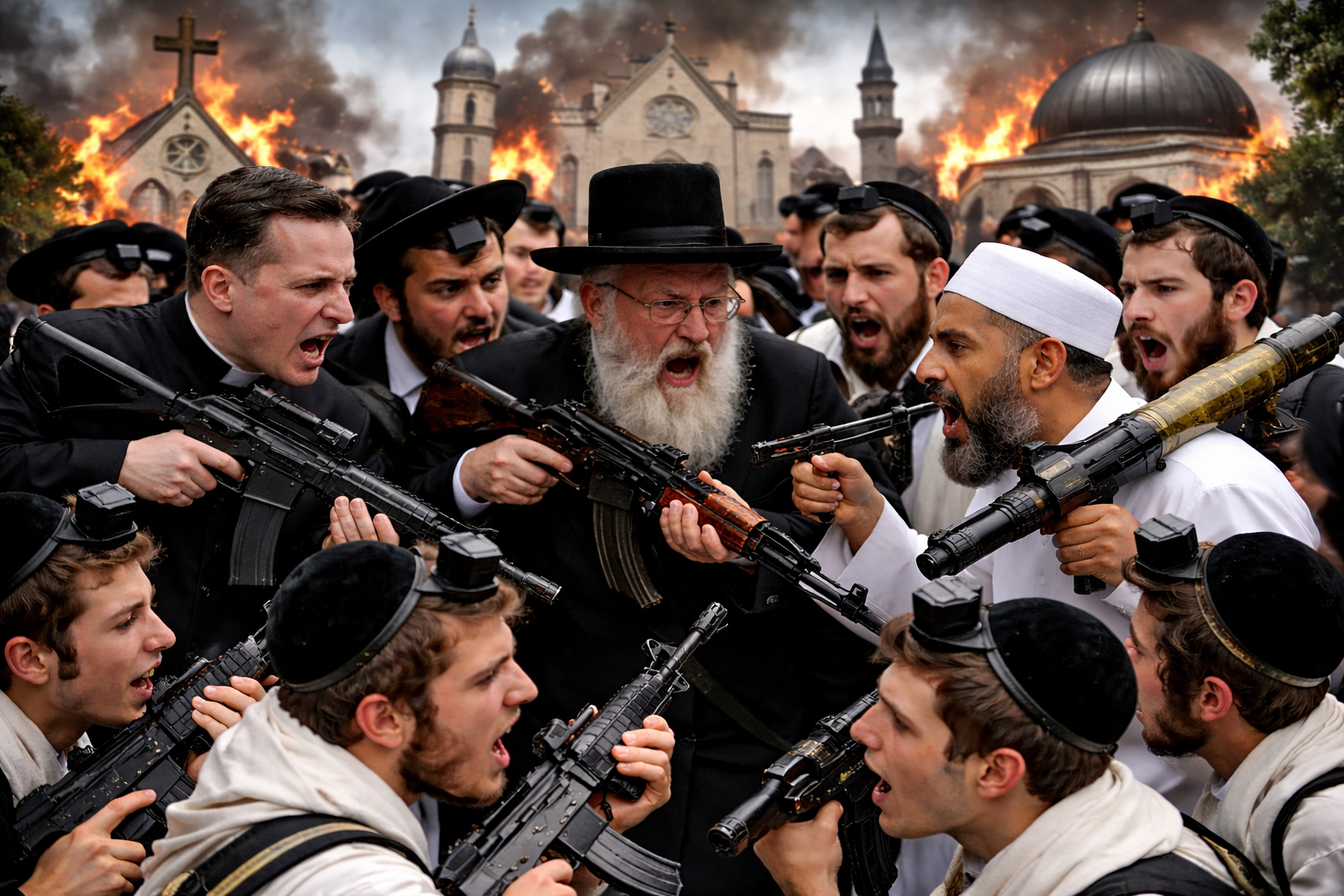
The starting point is simple and urgent.
It is time to remove religious authority from the machinery of the state.
This is not an attack on belief. People are free to believe, worship, and practice as they choose. The issue is power. When belief systems that claim divine authority gain control over governments, they gain access to law, enforcement, and ultimately weapons. That is where the risk begins.
Religion operates on fixed truth claims. Its authority is not derived from evidence or negotiation, but from conviction in what is held to be absolute. That structure may function in a private context, but when fused with political power it creates rigidity backed by force.
This dynamic is not theoretical. It is visible in the structure of modern states.
Iran is explicitly a religious state. Its constitution requires that all laws conform to Islamic criteria, and ultimate authority rests with a religious figure, the Supreme Leader, who controls key arms of government including the military, judiciary, and national security apparatus. Religion is not influencing the state. It defines it.
Israel is formally a Jewish state. Its national identity is tied directly to religion, and religious parties often hold decisive power in forming governments. Rabbinical institutions control major aspects of civil life such as marriage and conversion. Religious identity is embedded in law, citizenship, and territorial policy. The boundary between religion and state is not absent, but it is structurally intertwined.
The United States is constitutionally secular, yet in practice heavily shaped by religion. A large majority of members of Congress identify with a religious tradition, and highly organized religious blocs, particularly evangelicals, exert sustained influence over elections, judicial appointments, and national policy. Religion does not formally define the state, but it significantly influences its direction.
These three systems differ in form, but they converge on the same structural risk.
When fixed belief systems gain access to state power, they do more than shape policy. They shape leadership. Systems grounded in unquestionable authority tend to elevate leaders who mirror that rigidity, individuals who frame decisions in absolute terms, resist compromise, and justify actions through ideological certainty rather than adaptive reasoning. Over time, this creates a pathway for leadership that exhibits escalating extremism, reduced accountability, and in some cases, decision making that appears detached from pragmatic constraints.
Now consider what modern states control.
They control militaries, intelligence networks, and in some cases weapons capable of mass destruction. When rigid, non negotiable belief systems intersect with that level of power, and when leadership within those systems is selected or reinforced through ideological alignment rather than flexible judgment, the consequences of conflict are amplified even further.
Without state power, competing belief systems can argue, persuade, and organize. The damage they can inflict is limited. With state power, those same belief systems can legislate, enforce, and escalate conflict with overwhelming force.
That is the line that cannot be crossed.
A functioning society requires that laws be grounded in reasoning that can be challenged, debated, and revised. It requires that no authority be beyond question. It requires that governance remain flexible enough to adapt to reality, rather than fixed to doctrine.
This is not about eliminating religion. It is about removing its control over coercive systems.
When belief remains personal, pluralism is possible. When belief becomes state power, backed by force, pluralism erodes and conflict escalates.
The conclusion is not ideological. It is structural.
If societies want to reduce conflict, avoid escalation, and preserve the ability to coexist, they must ensure that religious authority does not control governments that wield military and destructive power.
Belief can remain free.
Power must remain accountable.
And the two must not be fused in a way that removes the ability to question, adapt, and negotiate in a world where survival depends on all three.