If you are Christian, you are Jewish - Programmed Obedience to Israel
Do you ever wonder why it seems that certain religions are closely aligned with and strongly support Israel, and why the U.S. government often appears aligned with Israel’s goals?
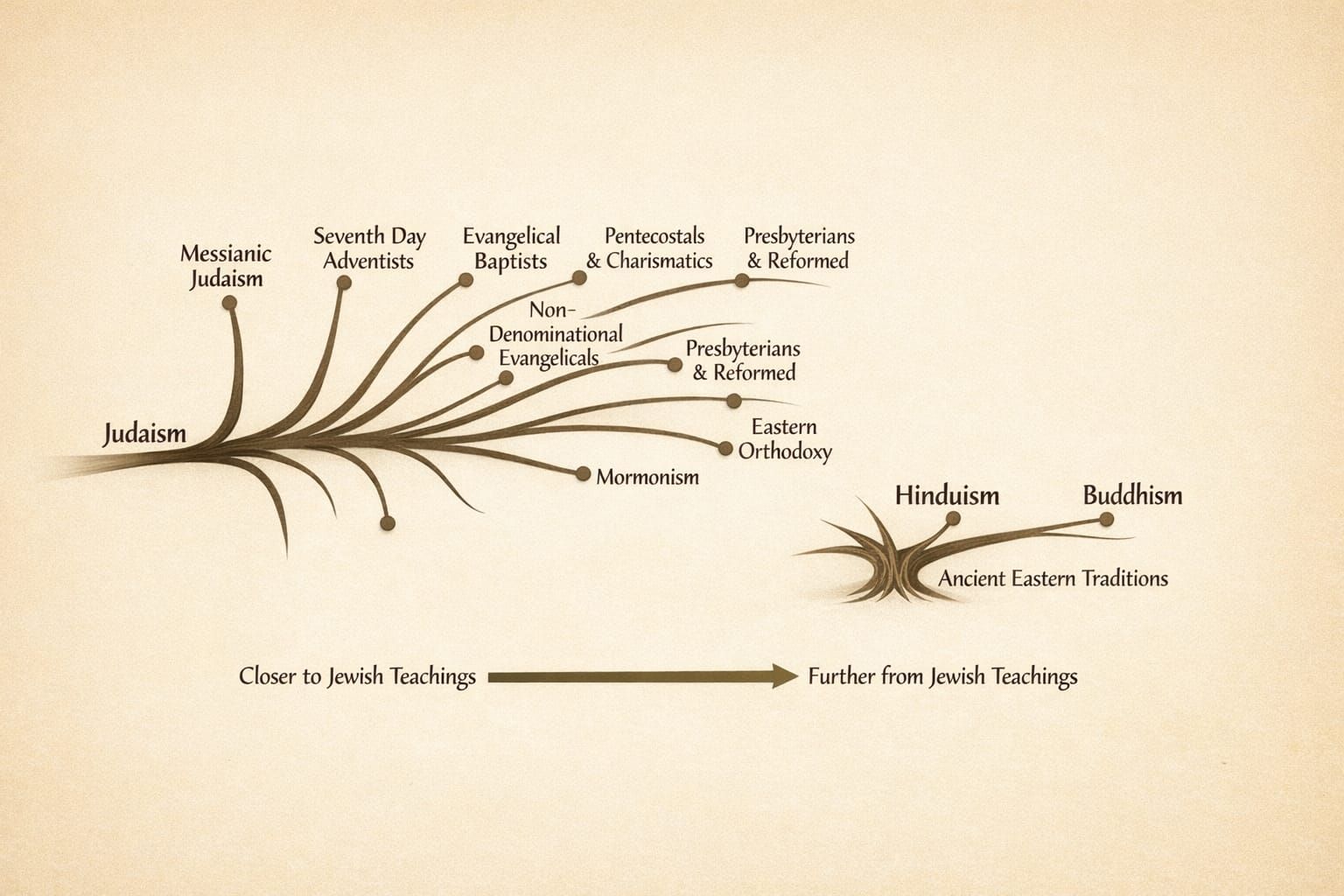
To understand that, you have to start at the root. Religion in America is not a scattered set of beliefs. It is a layered structure built on one foundation. Judaism.
At the top is Judaism itself. This is the source. The Torah, the covenant, the law, the identity. There is no divergence here. Everything else in the Abrahamic world branches outward from this core.
Just below it is Messianic Judaism. It preserves Jewish identity, language, and many practices, but introduces Jesus as the Messiah. That single shift creates a break, but the structure remains deeply tied to Jewish teaching.
Next are Seventh day Adventists. They pull heavily from the Hebrew Bible. They observe the Saturday Sabbath and often follow dietary patterns similar to Jewish law. But they reject the legal system as binding and reinterpret everything through a Christian lens.
Then come Evangelical Baptists and non denominational evangelical churches. These groups rely intensely on the Hebrew Bible, often reading it literally. They emphasize covenant, prophecy, and the central role of Israel. But they remove Jewish law entirely and center belief on salvation through Jesus.
Pentecostal and charismatic churches follow. They draw from Old Testament themes such as prophecy and divine power, but without the structure of law or covenant. The connection becomes experiential rather than legal.
In the middle are Presbyterian and Reformed traditions. These systems are built on covenant language drawn from the Hebrew Bible, but they reinterpret Israel as symbolic rather than national. The framework is intellectual, not literal.
Then come Lutheran traditions. They retain the Hebrew Bible but shift focus away from law and toward grace. The identity and legal structure of Israel fade further.
Below that are Methodist churches. These move even further from Jewish structure. The emphasis becomes ethics, personal growth, and grace. The Old Testament becomes background rather than foundation.
Anglican and Episcopal traditions continue this shift. They blend scripture with tradition and liturgy. Jewish law and national identity are no longer central to the system.
Then you reach Roman Catholicism and Eastern Orthodoxy. These retain the Hebrew Bible but layer on centuries of tradition, ritual, and institutional authority. The framework is no longer anchored in Jewish law or identity but in the Church itself.
Further down is Mormonism. It references Israel symbolically but introduces entirely new scripture and theology. The connection becomes abstract and reconstructed.
Then Islam. It shares figures like Abraham and Moses, but replaces the covenant structure, law, and narrative with its own system. The overlap is historical, not structural.
At the far end are Buddhism and Hinduism. These operate on entirely different assumptions about reality, self, and the divine. There is no shared foundation.
Now here is the key.
Every major Christian denomination above the midpoint is still built on the Hebrew Bible. They may reject Jewish law, but they do not reject the narrative. They inherit the story of Israel, the covenant language, and the prophetic framework.
Even when they diverge, they do not disconnect. They reinterpret.
Baptists read Israel literally but remove the law. Presbyterians reinterpret Israel symbolically. Methodists turn Israel into moral narrative. Catholics embed Israel into a broader church structure.
But none of them erase it.
They move away from Jewish law, but they remain anchored in Jewish story.
And that is where the alignment comes from.
Not obedience.
Structure.
If your entire religious framework begins with the Hebrew Bible, then Israel is never just another country. It is the origin point. It is where the narrative begins, where the covenant is established, where prophecy is rooted.
And that structure does not just live in churches. It carries into power.
Roughly seven out of ten Americans identify with the religious traditions described here. Yet in Congress, those same traditions make up well over nine out of ten representatives. Meanwhile, a rapidly growing share of Americans identify as non religious, yet they remain significantly underrepresented in national leadership.
That imbalance matters.
Because when the majority of governing power is held by traditions that are structurally rooted in the Hebrew Bible, the worldview that comes with that structure does not stay private. It shapes assumptions, priorities, and alliances.
The Constitution calls for a separation of church and state.
But when a dominant share of elected officials operate within religious frameworks that trace directly back to Judaic narrative, covenant, and prophetic structure, the separation becomes less clear in practice.
The alignment with Israel is not random. It is not purely strategic.
It is the downstream effect of a deeply embedded theological architecture that begins in Judaism, branches through Christianity, and remains active in the people who hold power.
The closer a tradition remains to that origin, the stronger the alignment appears.
And when those traditions are overrepresented in government, that alignment does not stay in belief.
It becomes policy.