The Promised Land as Political Engine
A significant strand of American evangelicalism reads the modern state of Israel as fulfillment of biblical prophecy, and this has translated into a durable political constituency shaping decades of U.S. foreign policy support for Israel.
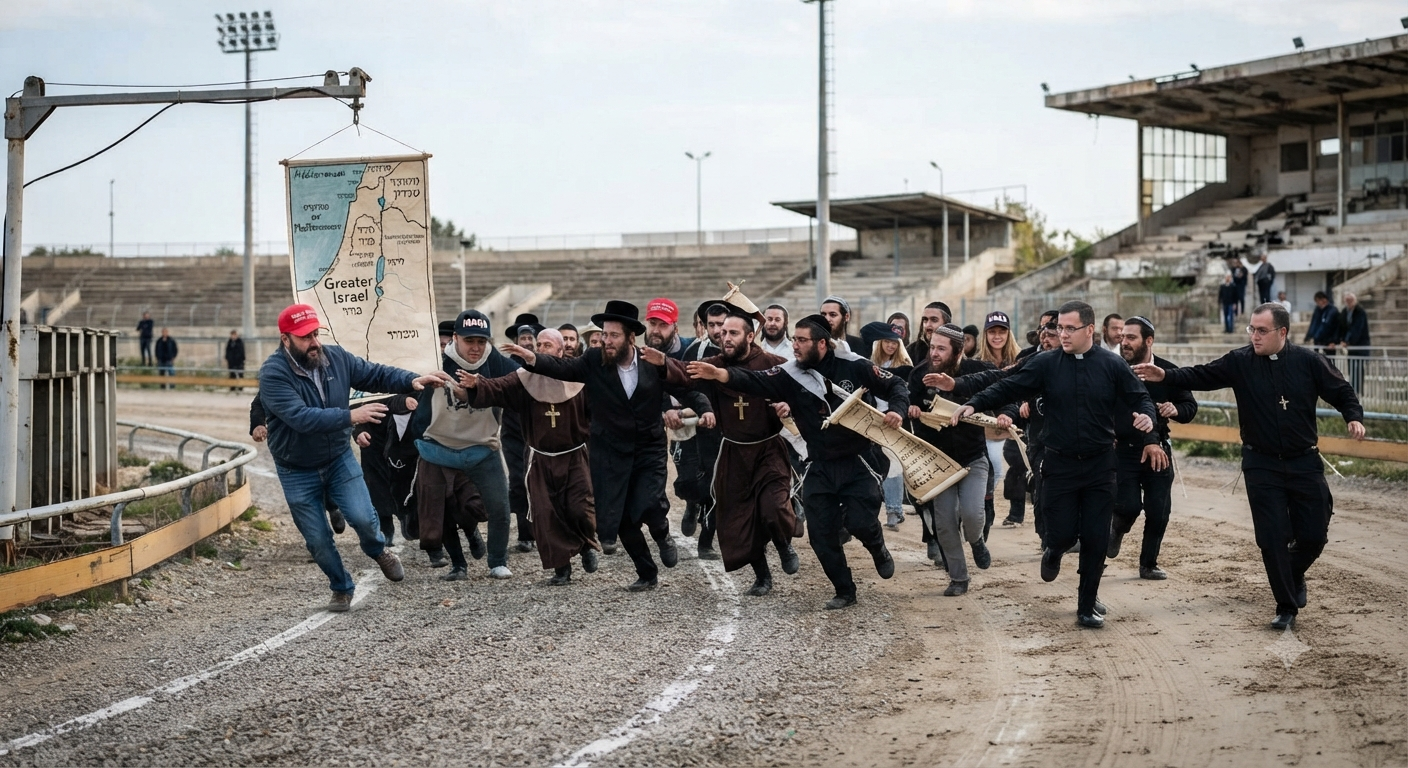
Every system that demands sustained obedience needs something to point toward, a horizon that justifies present sacrifice. Secular authoritarian systems use utopia, revolution, or national destiny. Religious political systems have often used land instead: a specific, mappable, defensible territory framed as divinely allocated. This converts an abstract spiritual promise into a concrete political project, because land can be lost, defended, and fought over in a way that salvation alone cannot. That is the mechanism worth examining here: how sacred narrative doesn't just inspire belief, but gets turned into policy, mobilization, and war.
The Crusades of the eleventh through thirteenth centuries are the clearest early example. Papal appeals framed the reconquest of Jerusalem as both a spiritual obligation and a military campaign. Indulgences promised heavenly reward for earthly service, and chroniclers described the capture of the city in explicitly theological terms. The historical record shows land and salvation fused into a single project, one that also happened to serve papal authority, feudal ambition, and trade interests in the Levant.
Religious Zionism offers a modern parallel. Rabbi Abraham Isaac Kook, and later his son Zvi Yehuda Kook, developed a theology holding that Jewish settlement of the biblical land itself constitutes a stage in messianic redemption. This became a driving ideological current behind the settlement movement after 1967, particularly through groups like Gush Emunim, which explicitly framed territorial expansion as religious duty rather than simply security policy.
Christian Zionism in the United States is a related but distinct case. A significant strand of American evangelicalism reads the modern state of Israel as fulfillment of biblical prophecy, and this has translated into a durable political constituency shaping decades of U.S. foreign policy support for Israel. It's a case where theology organizes not the believers' own land claim, but a foreign patron's backing of someone else's.
Existential threat rhetoric recurs across these episodes too. Crusade preaching invoked the desecration of holy sites. Modern debates over Israel and Palestine are frequently framed around annihilation, terrorism, or nuclear proliferation rather than territorial or political dispute alone. Fear of catastrophic loss compresses complex political negotiations into binary survival narratives, and those narratives are far more effective at sustaining public mobilization across generations than an ordinary policy dispute ever could be.
A fair account has to complicate this picture though. Explaining a century of Israeli Palestinian conflict primarily through theology sidelines the roles of Ottoman collapse, British Mandate decisions, Arab nationalism, the Holocaust and refugee crises, Cold War alignment, and resource and water politics. Many historians treat these material and secular factors as primary, with religion as one layer among several rather than the root cause.
It's also worth saying that most religious Jews, Christians, and Muslims engaged with these traditions do not experience their faith as manufactured obedience. Framing all devotion as elite manipulation denies believers their own agency and reasoning. And the authoritarianism framing is itself contestable, since democracies as well as authoritarian states have used sacred land narratives. That makes this a feature of political mobilization generally, not something unique to authoritarian systems. Comparable land narratives show up in Kashmir, Kosovo, and Northern Ireland, none of which are primarily authoritarian cases. Competing theological readings exist within each tradition as well, and many Jewish, Christian, and Muslim scholars reject land centered messianism entirely, arguing it is a minority or distorted reading of their own scripture.
What holds up well as evidence based history is this: sacred land narratives have repeatedly been instrumentalized by political and religious authorities to convert spiritual loyalty into sustained material mobilization. The Crusades and religious Zionist settlement theology are documented, specific cases of exactly that. What's harder to defend is treating this as the master explanation for an entire, multicausal geopolitical conflict, or treating all religious devotion within these traditions as functionally authoritarian.